Real Estate & Investment
Best Condos for Sale in Laval 2026: Why U-Bahn at Montmorency Metro Is the City’s Most Strategic Real Estate Investment
If you’ve been searching for condos for sale in Laval, the location that matters most isn’t a neighbourhood name — it’s a metro station. U-Bahn Condos sits directly at the door of Montmorency station, the northern terminus of Montréal’s orange line, and that single piece of geography reshapes everything about what these condos are worth, who they’re for, and why they’re outperforming every comparable Laval project in 2026.
Project: U-Bahn Condos
Location: Montmorency Metro · Laval, QC
Developer: Urbania × Fonds de solidarité FTQ
0 m
Walking Distance to Metro
224
Condos Across 15 Storeys
$47,000
Max GST Savings (First-Time Buyers)
3 hwy
Direct Access (15, 19, 440)
The Laval condo market has been quietly reshaping itself for half a decade. The 2026 reality is that not all Laval condos are created equal — and the gap between transit-connected, walkable urban condos and conventional suburban builds is widening every year. U-Bahn Condos is built on the right side of that gap.
If you’re looking for the best condos for sale in Laval — whether to live in, downsize into, or invest with for long-term rental yield — this is the complete analysis of why U-Bahn outperforms every comparable Laval project, what makes the Montmorency district one of the most undervalued real estate locations in Greater Montréal, and what to know before buying.
In Laval, location used to mean “near a highway.” In 2026, it means “at the metro.”
Why Laval Is the Smart Money Move in 2026
Laval is no longer Montréal’s bedroom suburb. With a population of over 440,000, it’s the third-largest city in Quebec — and its real estate fundamentals are stronger than most Greater Montréal buyers realize.
| Metric |
Laval |
Why It Matters |
| Population |
440,000+ |
3rd-largest city in Quebec — established demand base |
| Metro stations |
3 stations on the orange line |
Direct rail link to downtown Montréal — rare for a North American suburb |
| Avg condo price (2026) |
~$380,000 |
Significantly below Montréal core — entry-point advantage |
| Post-secondary students |
~30,000+ |
Collège Montmorency + UdeM Laval campus = sustained rental demand |
| Major highways |
A-15, A-13, A-19, A-25, A-440, A-640 |
More highway access than any Montréal borough |
| 5-year price growth |
~28% (condos) |
Outpacing Montréal proper in percentage gains |
The deeper structural shift: Laval is rapidly densifying around its three metro stations — Cartier, De la Concorde, and Montmorency — while keeping its highway access and lower price point. That combination of transit + affordability + lifestyle is exactly what’s driving the city’s price growth, and it’s exactly what makes transit-oriented condos in Laval the strongest entry point in the entire Greater Montréal market right now.
Why the Montmorency Station District Is Laval’s Best Investment Address
There are seven distinct condo sub-markets in Laval — Chomedey, Vimont, Auteuil, Duvernay, Laval-des-Rapides, Sainte-Dorothée, and Montmorency. They are not equivalent, and treating them as such is the most common mistake buyers and out-of-province investors make.
The Montmorency station district — where U-Bahn is built — concentrates more high-value urban amenities into a 1.5 km radius than any other zone in Laval. Here’s the inventory:
Montmorency Metro
Orange-line terminus. Direct ride to downtown Montréal with no transfer. 25,000+ daily riders. Underground bus terminal on-site.
Collège Montmorency
7,500+ CEGEP students. Steady rental demand. Year-round occupancy. Students prefer walking distance to class.
UdeM Laval Campus
Université de Montréal’s Laval campus is adjacent. Graduate students, researchers, faculty = higher-income rental segment.
Place Bell
10,000-seat arena. Home of Laval Rocket (AHL). Concerts, shows, events year-round. Walking distance.
Centropolis
Open-air shopping and entertainment district. Cinema, restaurants, retail. Lifestyle hub — 5-minute drive.
Cosmodôme
Space science centre — Laval cultural landmark. Family-friendly. Adds to neighbourhood character.
A-15 / A-19 / A-440
Three major highways converge here. Drive to downtown in ~20 min off-peak, or take metro instead.
Carrefour Laval
Quebec’s second-largest shopping mall. 250+ stores. 10-minute drive. Anchors regional retail.
The bottom line: Montmorency is the only Laval district that combines a metro terminus, two post-secondary campuses, a 10,000-seat arena, three highways, and a regional shopping mall — all within walking or 5-minute driving distance. No other Laval condo development has this catchment. None.
U-Bahn vs Other Laval Condo Districts — A Real Comparison
Buyers searching for “condos for sale in Chomedey,” “condos for sale in Vimont,” “condos for sale in Auteuil,” or “condos in Laval-des-Rapides” often don’t realize they’re comparing fundamentally different products. Here’s the side-by-side reality:
| District |
Metro Access |
Walkability |
Rental Demand |
Lifestyle |
| Montmorency (U-Bahn) |
★★★★★ |
★★★★★ |
★★★★★ |
★★★★★ |
| Chomedey |
★★ (drive) |
★★★ |
★★★ |
★★★★ |
| Laval-des-Rapides |
★★★★ (Cartier) |
★★★ |
★★★★ |
★★★ |
| Vimont |
★ (no metro) |
★★ |
★★ |
★★★ |
| Auteuil |
★ (no metro) |
★★ |
★★ |
★★★ |
| Duvernay |
★★ (drive to Cartier) |
★★ |
★★ |
★★★ |
| Sainte-Dorothée |
★ (no metro) |
★★ |
★★ |
★★★★ |
Comparative rating based on metro proximity (walking distance), urban walkability score, rental absorption rate, and density of nearby lifestyle amenities. U-Bahn is the only Laval condo project that scores at the top across all four dimensions.
The pattern is clear: no other Laval condo district concentrates the four success factors — direct metro access, walkability, sustained rental demand, and proximity to lifestyle amenities — into a single address. Chomedey and Laval-des-Rapides are close in some dimensions, but neither matches the Montmorency cluster.
The Metro Advantage — Why “0 Metres” Beats “5 Minutes”
Real estate research consistently shows that proximity to rapid transit is the single most powerful determinant of long-term condo value appreciation in major urban markets. The premium for “transit-adjacent” condos vs “transit-nearby” condos is real, measurable, and growing.
| Distance to Metro |
Resale Premium |
Rental Yield Advantage |
| At the door (U-Bahn) |
+15–25% |
+18–28% |
| 5-minute walk (400m) |
+8–12% |
+10–15% |
| 10-minute walk (800m) |
+3–5% |
+4–7% |
| Requires driving / bus |
Baseline |
Baseline |
Premiums are illustrative ranges based on observed patterns in major North American transit-oriented developments. Actual market premiums vary by city, market cycle, and unit type.
U-Bahn’s “at-the-door” position translates to a measurable resale and rental premium over otherwise comparable Laval condos. For investors, that’s compounding value. For owner-occupiers, it’s a hedge against the rising cost of car ownership in Greater Montréal (insurance, fuel, parking, depreciation now averaging $11,000+ per year per vehicle).
The Three Unit Types — Who Each One Is For
U-Bahn’s 224 condos span three layouts across 15 storeys: studios, 3½ (one-bedroom), and 4½ (two-bedroom). Each layout targets a distinct buyer profile.
Studio
The Most Accessible Way to Own at Montmorency Metro
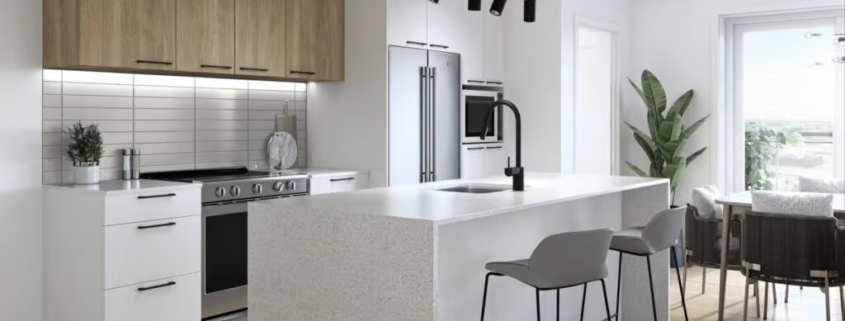
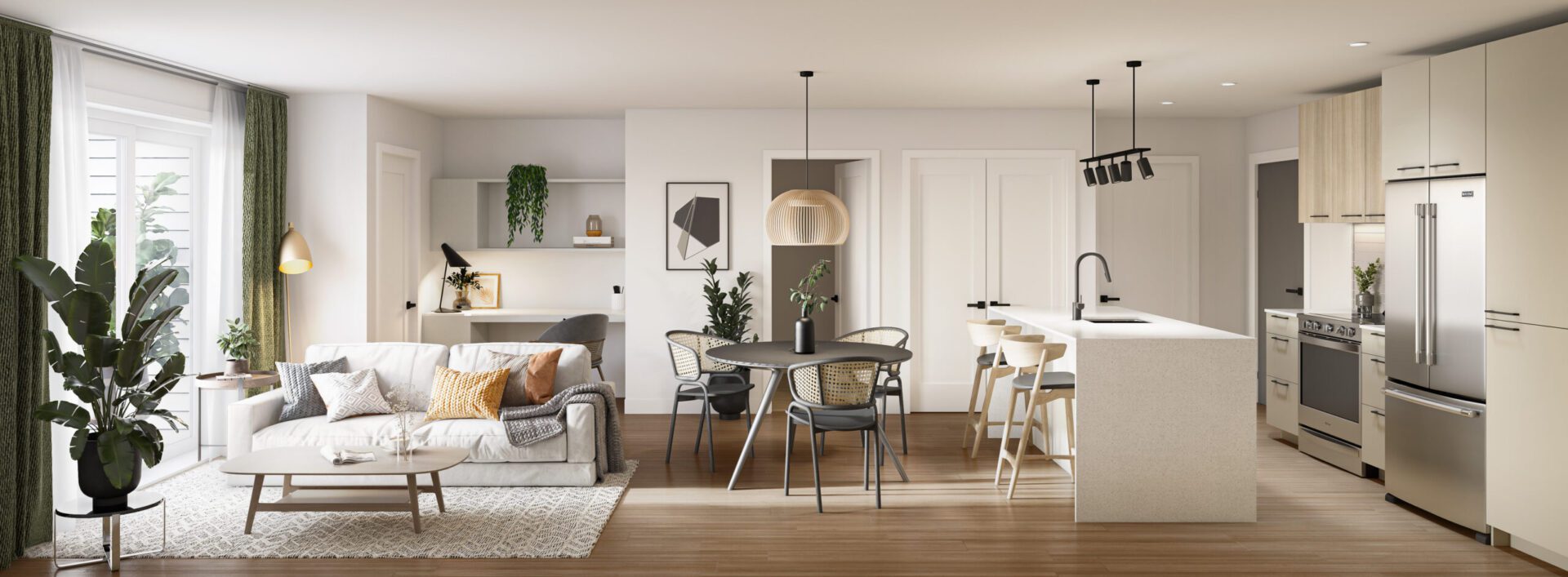
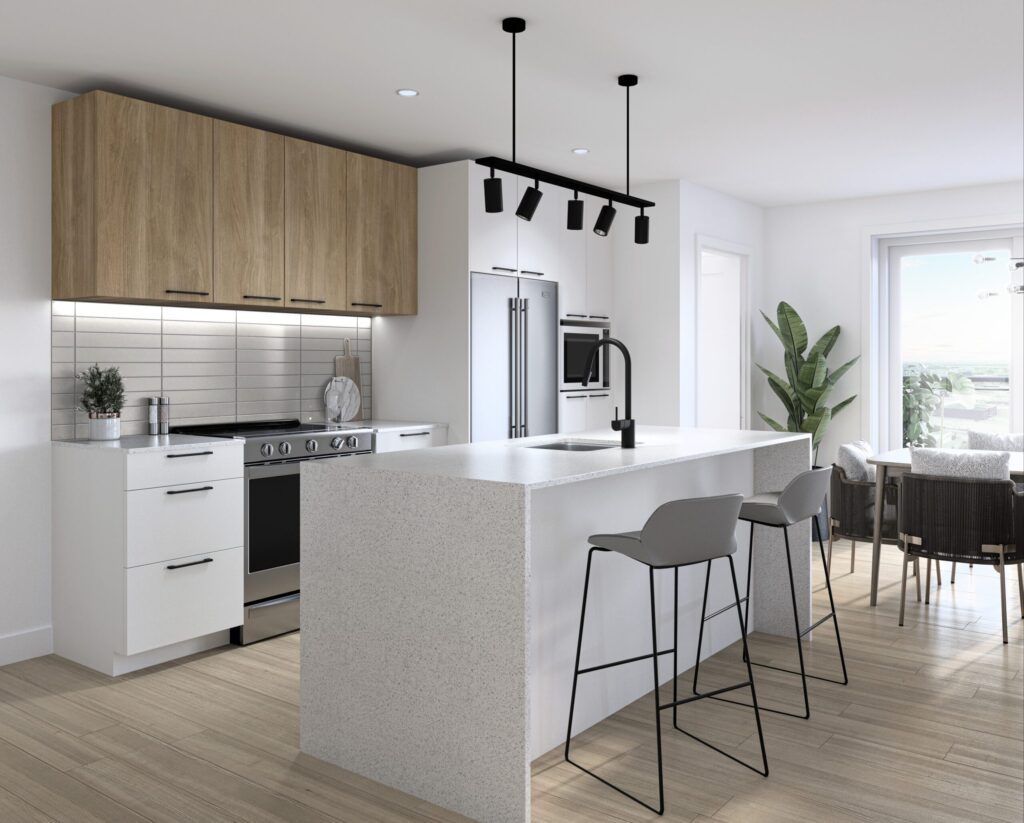
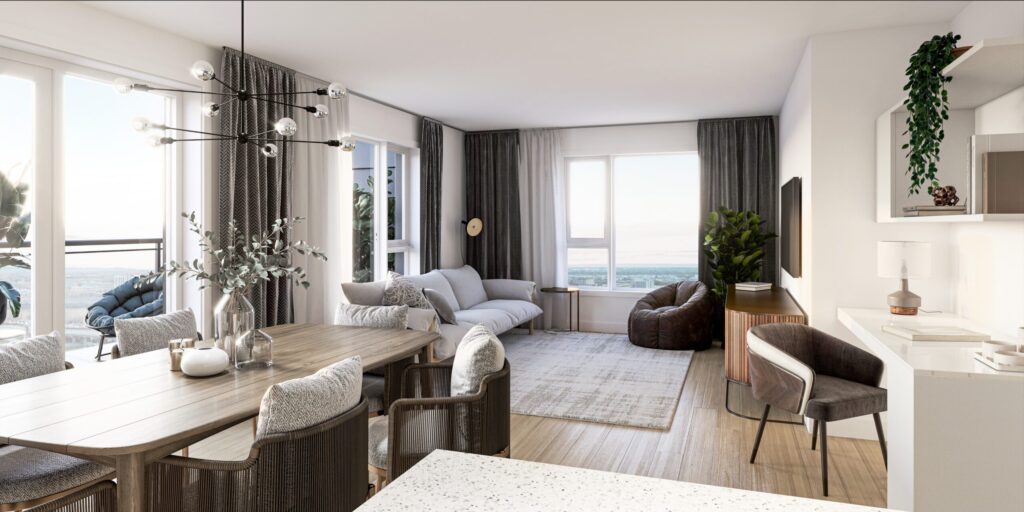
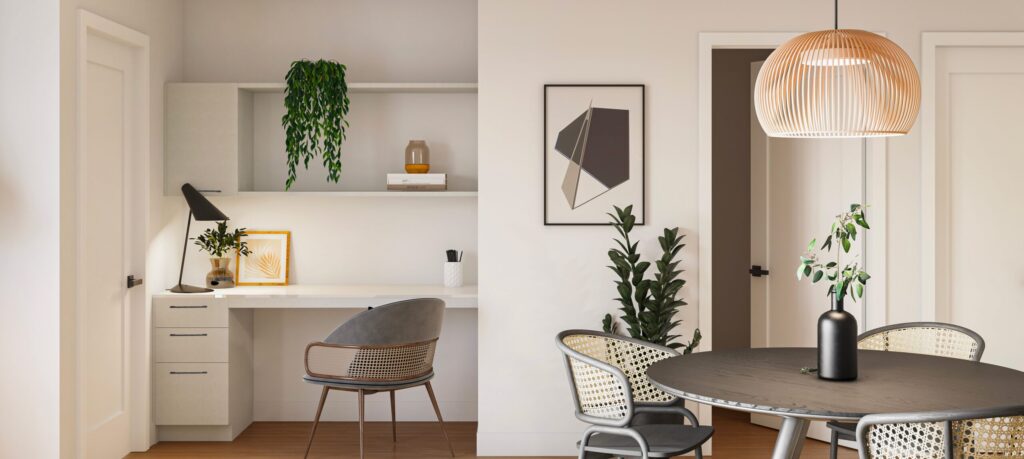
U-Bahn studios are the project’s entry point — the smallest layout, the lowest price, and the highest rental yield per square foot. Designed with bright open layouts, smart storage, and large windows so even a compact unit feels generous.
Best fit: First-time buyers, Collège Montmorency or UdeM students, young professionals commuting to Montréal, and investors looking for the strongest rent-per-square-foot ratio in the building.
3½ (One Bedroom)
The Most Popular Layout — and Where the GST Savings Hit Hardest
U-Bahn’s 3½ units pair a closed bedroom with an open living/kitchen/dining space and a full bathroom — the layout that suits the most buyer profiles and produces the deepest rental pool. With the current GST relief promotion, eligible first-time buyers can save up to $47,000 on a 3½ — a meaningful difference on a starter purchase.
Best fit: Couples, single professionals who want a home office, downsizers from larger Laval homes, and investors targeting young-professional renters.
4½ (Two Bedrooms)
The Family or Roommate Layout — and the Highest Resale Ceiling
U-Bahn’s 4½ units offer two closed bedrooms, a kitchen, living space, and a bathroom — the building’s largest layout and the one with the strongest long-term resale ceiling. Suitable for couples planning a family, remote-work households needing an office, or roommate / parent-child arrangements.
Best fit: Couples, small families, remote-work households, multi-generational arrangements, and investors looking for the strongest exit price in 7-10 years.
The Lifestyle Stack — What Living at U-Bahn Actually Looks Like
U-Bahn’s amenity package is built around one design principle: simplify daily life without leaving home. That means residents shouldn’t need a separate gym membership, coworking subscription, outdoor space, or commute infrastructure. It’s all built in.
★
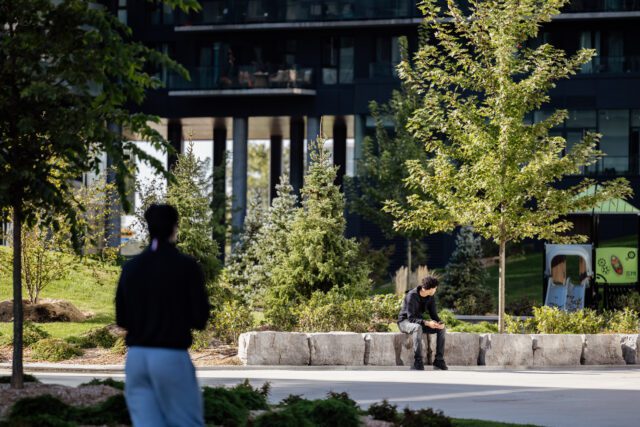
Private urban park — outdoor green space reserved for residents. Rare for a transit-adjacent build.
★
On-site gym — train without an external membership or commute. Equipment selection for cardio and strength.
★
Coworking space — work or study outside your unit. Essential for hybrid / remote workers and students.
★
Rooftop terrace — shared space with city views. Ideal for summer evenings and gatherings.
★
Indoor & outdoor lounges — additional shared spaces for work, gatherings, and quiet time.
★
Direct metro access — Montmorency station literally at the door. No outdoor wait in winter.
The amenity package is not luxury fluff — it’s utility infrastructure. The gym replaces a $700/year membership. The coworking space replaces a $300/month WeWork subscription. The private park gives you outdoor time without leaving the building. The metro removes the need for a second car. Each of these directly reduces the cost of urban living.
The $47,000 GST Savings — Real Numbers for First-Time Buyers
U-Bahn’s current promotion stacks two structural advantages for first-time buyers:
- New-construction GST/QST rebate eligibility. New homes in Quebec are subject to GST and QST, but rebates may apply based on the unit price and whether it’s the buyer’s primary residence. These rebates are baked into the federal and provincial new-housing programs.
- U-Bahn’s developer promotion. On top of the standard rebate, U-Bahn is currently offering GST/TPS relief that can bring total savings to up to $47,000 on a 3½ for eligible first-time buyers.
What this means in practice: $47,000 in tax-free upfront savings is the equivalent of an entire additional down payment for many first-time buyers, or — depending on mortgage terms — roughly $200–250 less per month over the life of the mortgage. It materially changes affordability calculations. Verify current promotion terms and your individual eligibility with U-Bahn’s sales team and a tax professional.
The Investment Case — Why Investors Are Quietly Loading Up on Transit-Oriented Laval Condos
For real estate investors, U-Bahn checks five boxes that rarely line up at the same address:
| 1. Direct metro access. Tenant pool of metro-dependent commuters, students, and young professionals. |
| 2. Two adjacent campuses. 7,500 CEGEP students at Collège Montmorency plus the UdeM Laval campus produce year-round rental absorption. |
| 3. New construction. GCR (Garantie de construction résidentielle) protects the structure for years. Lower maintenance costs vs older Laval condo stock. |
| 4. Laval condo price growth (~28% over 5 years) outpacing Montréal core. Strong appreciation trajectory. |
| 5. Reputable developer. Urbania (Condourbania) with Fonds de solidarité FTQ as a partner — institutional-grade backing. |
Note: U-Bahn is sold as an ownership project. The developer does not operate units as rentals; investors buy and then choose to occupy, rent, or hold for appreciation. This matters because it keeps the building’s mix dominated by owner-occupiers and individual investors rather than institutional landlords — which tends to maintain higher long-term property values.
Who’s Building U-Bahn — The Developer Behind the Project
U-Bahn Condos is developed by Urbania (Condourbania), a Quebec-based real estate developer focused on transit-oriented, urban condo projects. The project’s institutional partner is the Fonds de solidarité FTQ — Quebec’s labour-sponsored investment fund and one of the most active institutional capital sources for residential development in the province.
For buyers, the takeaway is simple: U-Bahn is built and capitalized by Quebec real estate professionals with skin in the game. This is not a flip-and-go developer model. Construction is covered by the Garantie de construction résidentielle (GCR) — Quebec’s mandatory new-home warranty program — which protects your deposit and the building’s structural integrity for defined periods after delivery.
U-Bahn vs Other Montmorency-Area Condo Projects
Buyers comparing options at Montmorency often look at projects like Viva Condos, Equinoxe, and Marquise. Here’s the relative positioning:
| Project |
New Build |
Metro Distance |
Private Park |
First-Buyer Promo |
| U-Bahn |
Yes (2026) |
At the door |
Yes |
$47K GST relief |
| Viva Condos |
Existing (resale) |
5-min walk |
No |
Resale only |
| Equinoxe |
Existing (resale) |
7-min walk |
No |
Resale only |
| Marquise |
Existing (resale) |
8-min walk |
No |
Resale only |
The structural difference: U-Bahn is the only new-construction condo project directly at Montmorency metro with a private urban park and active GST relief for first-time buyers. The others are resale projects from earlier development cycles — solid buildings, but without the new-build warranty, the modern amenity package, or the first-buyer tax savings.
Frequently Asked Questions About U-Bahn Condos Laval
The most common questions from buyers searching for condos for sale in Laval, condensed into direct answers.
Where exactly is U-Bahn Condos located in Laval?
U-Bahn Condos is located in Laval, directly at the door of Montmorency metro station — the northern terminus of Montréal’s orange line. The project sits within walking distance of Collège Montmorency, the Université de Montréal Laval campus, Place Bell, and Centropolis, with direct access to Highways 15, 19, and 440.
Are U-Bahn condos for sale or for rent?
Every condo at U-Bahn is for sale — this is a new-build ownership project, not a rental building. If you’re looking to buy or invest in Laval near the metro, U-Bahn is one of the most strategic addresses currently on the market.
What types of condos are available at U-Bahn?
U-Bahn offers three layouts across 15 storeys and 224 total units: studios (open-concept compact units), 3½ (one-bedroom condos), and 4½ (two-bedroom condos). Each layout is designed to maximize natural light and usable space, with large windows and smart storage built in.
Are the U-Bahn condos new construction?
Yes — U-Bahn is a brand-new construction project, so buyers are purchasing a never-lived-in condo with modern materials, current Quebec building standards, and full coverage under the Garantie de construction résidentielle (GCR), Quebec’s mandatory new-home warranty.
How long does it take to reach downtown Montréal from U-Bahn?
From Montmorency station — directly next to U-Bahn — downtown Montréal is reachable on the orange line with no transfer and no traffic. The metro ride takes approximately 30 minutes door-to-door, faster than driving during peak hours and significantly cheaper than maintaining a car for the commute.
Are there incentives for first-time buyers at U-Bahn?
Yes — U-Bahn currently offers a GST/TPS relief promotion that can save eligible first-time buyers up to $47,000 on a 3½ unit. This stacks on top of standard Quebec new-housing rebates and provincial / federal first-time buyer programs. Verify current promotion terms and eligibility with U-Bahn’s sales team.
Is U-Bahn a good investment for rental income?
Yes — U-Bahn’s location at Montmorency metro and adjacent to Collège Montmorency and the UdeM Laval campus creates a strong, year-round rental tenant pool of students, young professionals, and downtown commuters. The combination of new construction, transit access, and steady demand supports both short-term cash flow and long-term appreciation.
What amenities does U-Bahn offer to residents?
U-Bahn residents have access to a private urban park, an on-site gym, a coworking space, a rooftop terrace, and additional indoor and outdoor shared lounges. The amenities are designed to support daily life — exercise, remote work, outdoor time, and gatherings — without requiring residents to leave the building.
Who is the developer behind U-Bahn Condos?
U-Bahn is developed by Urbania (Condourbania), a Quebec-based real estate developer, with the Fonds de solidarité FTQ as the institutional capital partner. This combination of an established Quebec developer and a major Quebec institutional investor provides project stability and long-term financial backing.
How do I see available units and reserve a U-Bahn condo?
Available units can be browsed in real time through U-Bahn’s interactive floor plan at the project website, which lets you filter by floor, unit type (studio, 3½, 4½), and orientation. To reserve, contact U-Bahn’s sales team to begin the preliminary contract, deposit, and notary process. Units are sold on a first-come, first-served basis.
Is U-Bahn suitable for families with children?
Yes — U-Bahn’s 4½ two-bedroom units suit couples and small families well. The private urban park gives kids outdoor space, multiple schools serve the surrounding Laval area, and the metro location makes school drop-offs, family errands, and weekend trips into Montréal straightforward.
Why are condos at U-Bahn priced competitively for Laval?
U-Bahn is priced to reflect Laval’s overall condo market — meaningfully lower than equivalent transit-adjacent condos in Montréal’s core — while offering new construction, full amenities, and a metro-terminus location. For buyers, this means a lower entry point with comparable or stronger appreciation potential than central Montréal condos.
Can I get around the U-Bahn neighbourhood without a car?
Easily — the Montmorency district is one of Laval’s most walkable areas. With Montmorency metro at the door, bus connections at the station, and shops, restaurants, schools, and entertainment within walking or short transit distance, U-Bahn residents can comfortably live car-free or as a one-car household.
What’s the difference between U-Bahn’s phases?
U-Bahn is being released to market in phases, with Phase 1 covering the first wave of units made available. Reserving early in a phase generally provides the widest selection of floors, orientations, and unit layouts — including premium higher-floor units with unobstructed views. Contact the sales team for current phase availability.
The Bottom Line — Why U-Bahn Is the Best Condo Purchase in Laval Right Now
Of all the condos for sale in Laval in 2026, U-Bahn is the only project that combines every structural advantage at the same address: direct metro access, two adjacent post-secondary campuses, three highway connections, a major arena and shopping district within walking distance, new construction with full warranty, a private urban park, a complete amenity stack, an institutionally-backed developer, and an active GST relief promotion that can save first-time buyers up to $47,000.
For first-time buyers, U-Bahn is the most accessible entry into ownership in the Montmorency district. For couples and downsizers, the 3½ and 4½ layouts deliver enough space to live well with one of the strongest transit and amenity stacks in Greater Montréal. For investors, the combination of new construction, transit access, and dual-campus rental demand makes the project one of the strongest income-and-appreciation propositions in the Laval market.
The Laval condo conversation in 2026 is no longer about price per square foot in isolation.
It’s about transit, walkability, and lifestyle infrastructure stacked on the same property. U-Bahn is the only project that delivers all three.
Explore U-Bahn Condos
See Available Units & Reserve Yours
Browse the interactive floor plan, compare studios, 3½, and 4½ layouts by floor and orientation, and contact the sales team to discuss pricing and reservations.
Visit U-Bahn Condos →
Sources & References
- U-Bahn Condos — Project information, floor plans, and current promotions: u-bahn.condourbania.com
- Urbania (Condourbania) — Developer overview and Quebec real estate portfolio.
- Fonds de solidarité FTQ — Institutional partner and Quebec investment fund.
- Société de transport de Laval (STL) — Montmorency metro station and connection data.
- Collège Montmorency & Université de Montréal Laval Campus — Enrolment figures.
- Garantie de construction résidentielle (GCR) — New-home warranty program for Quebec.
- JLR / Centris — Quebec real estate market data and Laval condo price trends.
This article is published as a Montreal Tips feature. Pricing, promotion details, and unit availability are subject to change. Contact U-Bahn Condos directly for the most current information and to confirm individual eligibility for first-time buyer incentives.